
Picture an organization that does everything right. Windows and Linux servers fully patched. EDR deployed on every host. Multi-factor authentication. Network segmentation. A SOC watching the alerts around the clock. And yet an attacker walks out with the contents of a domain controller — without ever running a single piece of malware inside those servers.
That is not a hypothetical. On 19 November 2026, Google Threat Intelligence Group (GTIG) and Mandiant published their analysis of exactly this: a suspected China-nexus espionage actor they track as ARMORY CASTLE (formerly UNC5221) chained two zero-days to reach the heart of a VMware vSphere environment and extract data straight from virtual disks. The guest operating systems were never the battlefield. The control plane was.
This is the kind of attack that matters even if you have never touched VMware — because every modern architecture has a control plane, and almost nobody defends it like one.
What actually happened
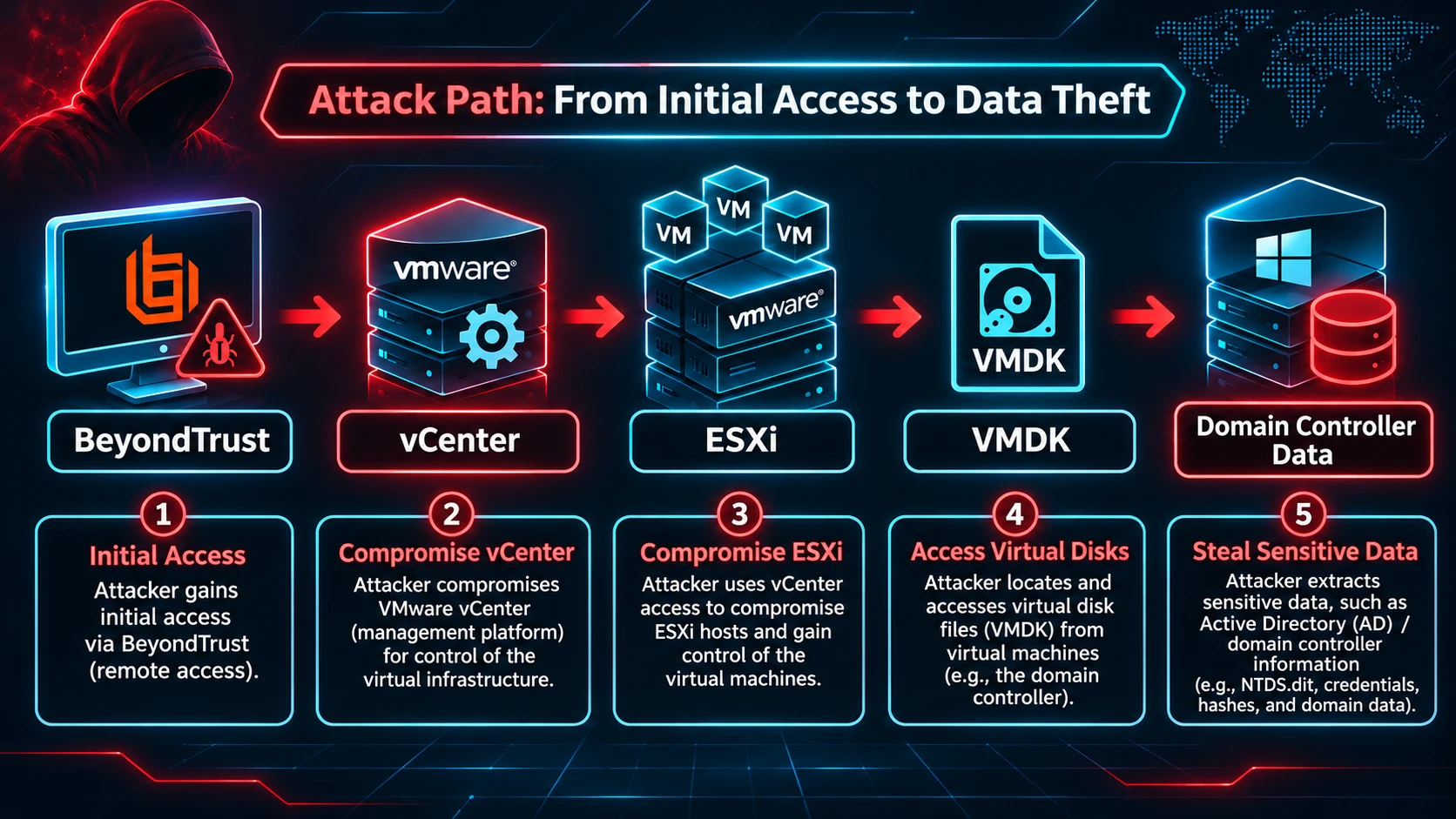
According to Mandiant’s forensic reconstruction, the operation ran in stages, far from a single exploit fired at a single box:
- Initial access (late August 2026): exploitation of CVE-2026-102764, a zero-day in BeyondTrust Remote Support — a remote-support appliance that, by its very function, enjoys privileged connectivity inside the network. BeyondTrust fixed it in patch BT26-05.
- Lateral movement: from the compromised appliance to an internal Linux appliance with lighter security coverage, then privilege escalation to root.
- Control-plane compromise (early September 2026): exploitation of CVE-2026-123890 in VMware vCenter, using a custom Go tool named BONESAW.
- Identity forgery: extraction of vCenter’s identity secrets, creation of SSO administrator accounts, and Golden SAML–style token forgery with a second tool, SAWSNAKE.
- Hypervisor access and data theft: root SSH onto ESXi hosts, then reading files directly off the virtual disks — pulling NTDS, SYSTEM and SECURITY hives out of a domain controller’s
-flat.vmdkwithout ever logging into Windows.
Crucially, vCenter was not the entry point. It was a later stage of a lateral-movement operation. You can keep vCenter off the public internet and still be at risk if another compromised internal system can reach its management interfaces.
The control plane: why this matters even without VMware
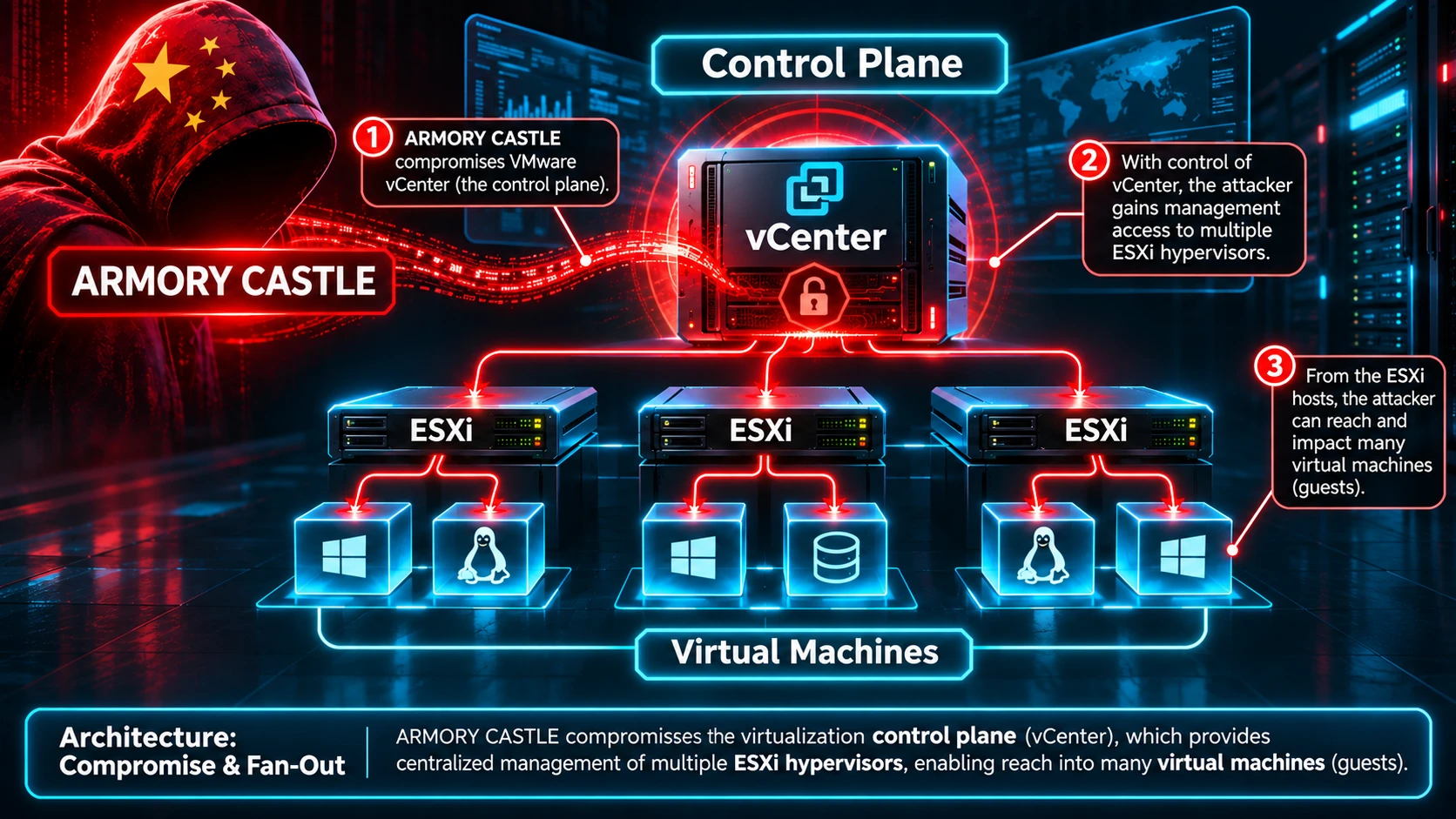
To understand the attack, separate three layers:
- ESXi — the hypervisor. It runs the virtual machines and governs their CPU, memory, storage and virtual networking. Its position in the stack gives it capabilities over the guests that do not depend on the Windows or Linux credentials used inside each VM.
- vCenter — the control plane. The centralized console that manages many ESXi hosts: inventory, permissions, configuration, storage operations. Compromise it and you can act on virtual machines without necessarily authenticating into their operating systems.
- The virtual machines — the guests. This is where we install antivirus, EDR and monitoring agents. But controlling a guest and controlling the infrastructure that administers it are two very different things.
The uncomfortable lesson: an attacker does not need to beat every defense inside the guest OS if they can seize the platform that administers it. That is the shift in perspective that should drive your defensive strategy — and it applies, by analogy, to AWS IAM, Azure, Google Cloud and Kubernetes just as much as to VMware.
The second zero-day: CVE-2026-123890
This is the technical core. CVE-2026-123890 is a critical authentication-bypass flaw in VMware Directory Service. Per Mandiant, it affects the Secure Remote Password (SRP-6a) mechanism implemented over DCE/RPC, reachable through the rpc_srp_verifier service on TCP/2012. Weaknesses in the cryptographic and authorization logic — compounded by predictable UUIDv1 identifiers — let an attacker with network access establish an authenticated session as administrator@vsphere.local without knowing the password.
From there, ARMORY CASTLE abused the vmdirdbcp RPC interface to exfiltrate vCenter’s directory database (data.mdb), a treasure trove of identity material. Broadcom rated the flaw CVSS 9.8 (critical) in advisory VMSA-2026-0009.1 and shipped fixes for vCenter 9.1.x, 9.0.x, 8.0 and VMware Cloud Foundation. There is no official workaround — patching is the fix, and restricting connectivity to the vulnerable services reduces exposure but does not replace it.
One subtlety worth repeating: this is not the same bug as CVE-2026-59309 (an LDAP path in vmdir on TCP/389 and 636). BONESAW was observed running successfully against a server that was already patched against CVE-2026-59309. Fixing the first flaw did not close the second.
Golden SAML: why MFA is not a magic shield
One of the most instructive phases is the use of SAWSNAKE to perform Golden SAML–style attacks. SAML lets an identity provider issue a signed assertion that other services trust as proof of authentication. If an attacker steals the private key used to sign those assertions, they can forge tokens that look like they came from a legitimate authority.
SAWSNAKE parsed data.mdb, extracted private keys and trusted certificates, generated signed SAML assertions and obtained administrative session cookies — impersonating identities to vCenter. The consequence for MFA-centric strategies is blunt: multi-factor authentication does not protect you if the attacker compromises the authority that issues or validates the tokens. MFA is not useless; it means the security of your signing keys, identity services and trust relationships is every bit as important as authenticating the user.
For the SOC, the takeaway is uncomfortable but essential: a technically valid authentication is not necessarily a legitimate one. When a signing key may be compromised, reviewing failed logins is not enough — you must investigate accepted sessions, newly created identities, privilege changes and the integrity of your trust infrastructure. (If that sounds like the kind of alert-fatigue nightmare that burns SOC teams out, we wrote about exactly that.)
Why your EDR never sees it
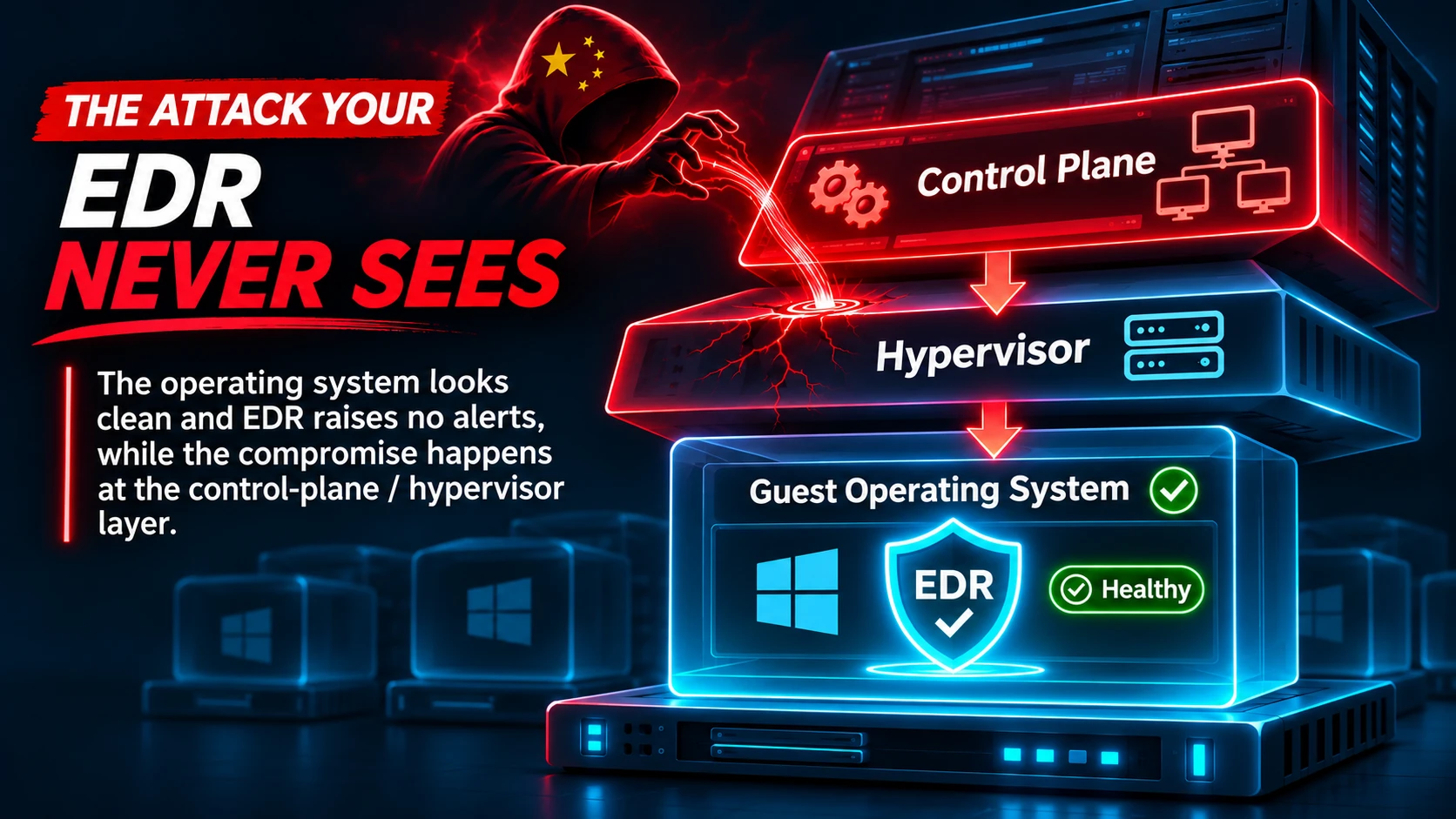
The EDR agent inside each virtual machine can be running perfectly, fully updated, raising no alerts — and still be blind. It watches the guest. The attacker is one floor below, reading the guest’s disk image from the hypervisor and copying files out of the datastore. No malicious process runs inside Windows. No suspicious login appears in the Windows event log. The theft happens in a layer the guest agent cannot observe.
That is the single sentence to take away: your EDR may be working — but it will not see what happens from the hypervisor.
How to defend your control plane
No single measure stops every intrusion, least of all one built on zero-days. But this incident shows several points where defenders could have broken the chain:
- Treat vCenter as a Tier-0 asset. In an Active Directory environment its compromise is comparable to compromising your most critical identity systems. Administer it with correspondingly strict controls.
- Segment the management plane. Keeping vCenter off the internet is not enough; restrict which internal systems can talk to its interfaces. A remote-support appliance should not automatically reach TCP/2012, 443, 5480 or 22 on vCenter. Enforce it with independent, verifiable controls — ideally outside the system you are trying to protect.
- Use privileged access workstations. Administer vCenter and ESXi from controlled, dedicated stations with distinct identities, never from any machine on the network.
- Centralize logs before the incident. Ship VCSA and ESXi logs to a protected external store, and verify the appliance’s OS audit (auditd) is actually being forwarded — the default VCSA syslog configuration does not guarantee it. A privileged attacker can wipe local logs.
- Monitor integrity of critical config files, SSH keys, systemd services, SUID changes, unexpected binaries, authentication mechanisms and new privileged accounts.
- Restrict outbound traffic. Infrastructure appliances should not have unrestricted internet egress; an allowlist-based policy hampers C2 and exfiltration.
- Patch — but do not depend on patching alone. During the window a vulnerability is unknown, no patch exists. Segmentation, least privilege, monitoring and protection of identity services are precisely what reduce the blast radius of the next zero-day.
And if you suspect vCenter is already compromised, do not stop at patching and changing the admin password: the attacker may hold keys, tokens, accounts and footholds in dependent systems. A proper response means contention, forensic preservation, an identity-centric investigation (SSO accounts, STS signing-key integrity), ESXi review, scope assessment reaching into Active Directory, and recovery that invalidates compromised cryptographic material. Changing a password does not neutralize a stolen signing key.
Indicators, detection and the full technical report
The published investigation includes network indicators, a MITRE ATT&CK mapping, threat-hunting guidance and proposed Sigma rules for the SOC. We have compiled all of it — the full chronology, the technical breakdown of both zero-days, the TTPs, the ATT&CK matrix, the Sigma detections, the IoCs, the Pyramid of Pain and a prevention and incident-response playbook — into a detailed report you can download:
📄 Download the full technical report (PDF)
If you want to know whether your own site or infrastructure shows signs of compromise, our free PathScan check is a good starting point, and our research hub collects our other DFIR and threat-intelligence work. For an incident, talk to us.
The lesson, in one question
This case does not prove that AWS, Azure or Google Cloud share VMware’s bug — CVE-2026-123890 is specific to vCenter. What it proves is architectural, and it travels to every platform where a control plane governs the resources beneath it. The right question is no longer only:
“Is the operating system protected?”
It is also:
“Who can administer that system from outside — and what happens if that authority is compromised?”
Sources
- GTIG & Mandiant — ARMORY CASTLE Exploits vSphere (19 November 2026).
- GTIG & Mandiant — ARMORY CASTLE Exploits BeyondTrust (15 October 2026).
- Broadcom security advisory VMSA-2026-0009.1 (CVE-2026-123890, CVSS 9.8).