

The cybersecurity industry operates on a fundamental asymmetry: the attacker only needs to be right once; the defender, every time. This maxim, far from being just a technical rule of network architecture, is the foundation of an ecosystem that subjects its professionals to extreme cognitive and emotional loads. We have modeled threats and vectorized attacks, but we have ignored the psyche of those who execute and contain them.
This analysis is not just a clinical X-ray of the industry; it is a mirror. Understanding the neuroscience behind each specialty is the first step toward professional self-awareness. It is the tool to predict your own breaking points, identify what (and who) you need to protect yourself from, and, above all, decide which path to take in your career based on your own emotional architecture, not just a list of technical certifications.
Cognitive theory: the heuristics of suspicion and the flow state

A hacker’s brain operates through divergent thinking and the systemic search for edge cases. Faced with a system, their mind doesn’t assimilate how it should work, but rather where it collapses. This generates two primary psychological phenomena:
- The dopamine loop. Achieving a security bypass requires abstracting multiple layers simultaneously (network, memory, application). This induces a deep state of flow and a highly addictive dopamine spike, justifying the grueling hours of technical immersion.
- The heuristics of suspicion (mental zero-trust). The constant training to find flaws generates a permanent cognitive bias. The professional develops chronic skepticism, a hypervigilance that makes it difficult to disconnect and often seeps into their personal relationships.
When comparing this profile with an AI engineer, the cognitive difference is staggering. The hacker operates in a deterministic and destructive environment (seeking the anomaly to collapse the system), demanding extreme tolerance for ambiguity. The AI engineer operates in a probabilistic and synthetic environment (seeking the pattern to build a model), demanding tolerance for passive frustration. One looks for the glitch in the matrix; the other tries to build it.
The operational board: Red Team, DFIR and the weight of the Purple Team
If you are deciding your future or evaluating why you feel exhausted, you must look at the stress pathology associated with your specific trench.
- Red Team (the paradox of ego and friction). They live on the offensive. Their mental load lies in the need for constant one-upmanship. However, their main cause of burnout is organizational: their operational success is politically perceived as a failure of the internal team. They operate in a constant environment of friction where their technical brilliance often generates corporate resentment.
- Blue Team and DFIR (trauma, hypervigilance and the front line). The DFIR (Digital Forensics and Incident Response) specialist is the ER surgeon of the digital world. They don’t just analyze logs; they contain corporate hemorrhages. The human brain is not designed to sustain a continuous state of red alert. They suffer from «alert fatigue» and the erosion of sustained attention. They live in a reactive position, dealing with the trauma of the incident and a burnout that is hard to avoid without strict containment policies: in a survey of 468 SOC analysts, more than 70% said they felt burned out. If you choose DFIR, you choose the adrenaline of the rescue, but you must bulletproof your mental health against hypervigilance.
- Purple Team (technical empathy and the center of gravity). They are the translators caught in the crossfire and the most cognitively complex profiles. Their challenge is extreme context-switching: they must understand the arrogance of the attack vector and immediately internalize the fatigue of the defender to create realistic mitigations. They require above-average emotional intelligence. They are the bridge over the corporate abyss. If you aspire to this role, your greatest asset won’t be your knowledge of MITRE ATT&CK, but your ability to absorb the friction between the Red’s ego and the Blue’s trauma without breaking yourself.
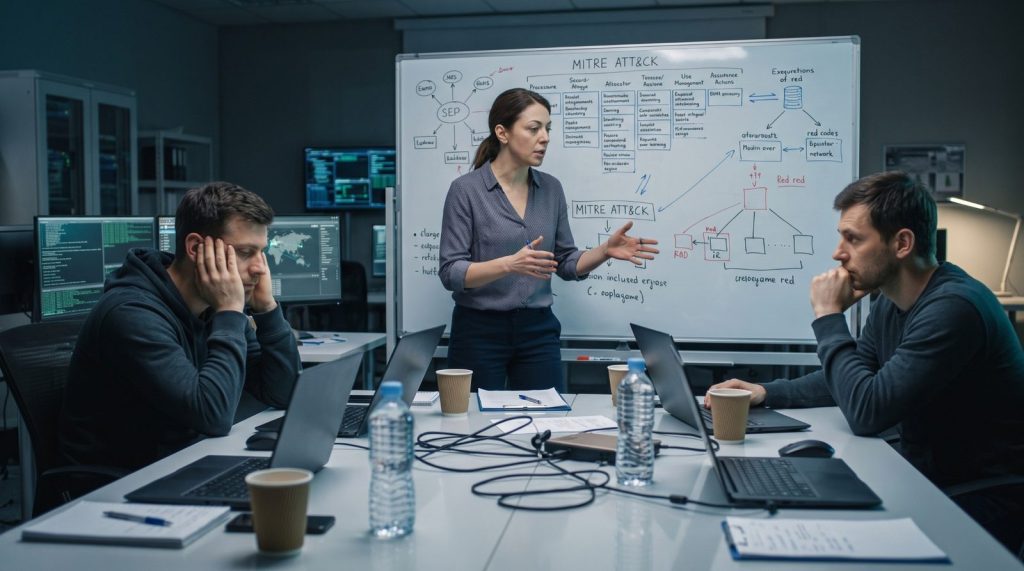
Added to this role-based wear and tear is the gender gap. Women, around 22% of security teams according to ISC2, bear a double cognitive load: on top of the technical stress comes an environmental toll, the imposter syndrome fed by the pressure of having to over-prove their competence daily in a male-dominated environment. In a KPMG study of 750 executive women, 75% said they had experienced it and 85% believe it is common among women in corporate life.
The recruiter’s blind spot: why talent escapes

Talent Acquisition and HR departments write job postings demanding SIEM proficiency, malware analysis, OSCP or GIAC certifications, and five years of experience.
But how do they classify the emotional capacity needed to survive in a SOC? Do they account for a DFIR analyst’s tolerance for ambiguity or the technical empathy required for a Purple Team architect in their interviews? The answer is no.
They evaluate hard skills and omit the candidate’s psychological architecture. That is why professionals are hired for their resumes and quit because of their cognitive burnout. High-level talent is not retained with «emotional salary» or foosball tables; they are retained by managing their mental load. The Red Team demands challenges without bureaucracy; the DFIR team demands immunity to burnout and the right to deep, real disconnection after an incident.
Academia has measured these factors, but the reality of the trenches is much harsher. Knowing these profiles is your first step to taking control of your career. To audit the real mental and emotional health of the sector, I have launched an empirical investigation; you will find the survey in the LinkedIn post linked below. If you are (or aspire to be) part of this ecosystem, contribute your vision. The goal is for the next edition of this document to pit clinical literature against our own real-world data, forcing the industry (and recruiters) to change the rules of the game.
Join the research and the debate
This article outlines the clinical theory, but the actual reality is being debated right now within the community.
👉 Go to my LinkedIn post, where the community is voting on which role suffers the most burnout.
Take part in the quick poll, leave a comment with your experience, and I will tag you as a co-researcher when I publish the second edition, pitting these clinical studies against our own real-world data. Your professional scars matter!
Sources
- Tines survey of 468 SOC analysts on burnout (Dark Reading).
- ISC2 2025 Cybersecurity Workforce Study: women make up 22% of security teams (ISC2).
- KPMG, Advancing the Future of Women in Business: imposter syndrome among 750 executive women (Los Angeles Business Journal).
- The rest of the text is the author’s analysis and opinion, not a clinical study. The second edition will test this theory against the survey data.